Went over basic Set Theory too - 1. Set Theory
Sample space - the set of all possible outcomes of an experiment
An event is a subset of the sample space
disjoint - unique or not intersecting or something
Theorems
probability of the sample space must sum to 1
probability of any event must be between 0 and 1
the probability of the union of all the events is equal to the summation of the probabilities of each event
If , then
For any 2 events,
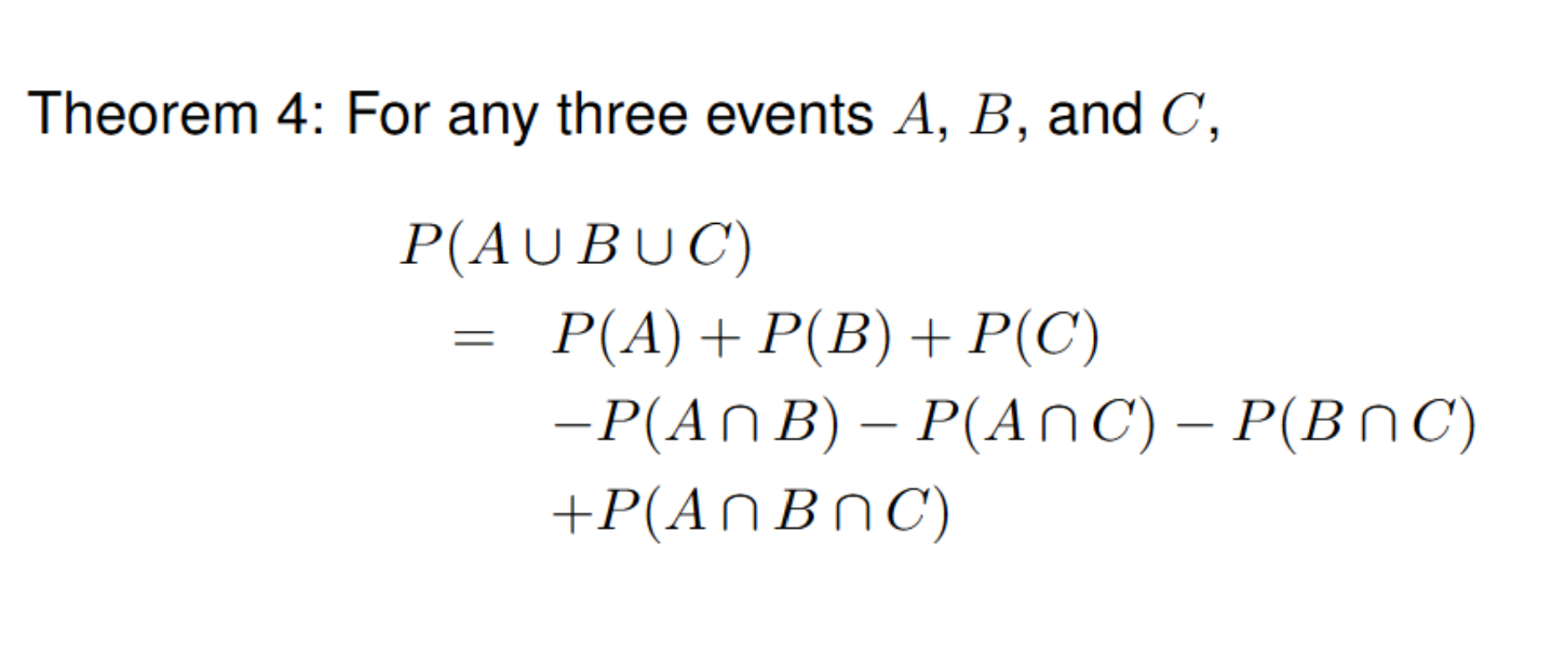
Why does Inclusion Exclusion add the intersection back?
Because it counts the subtracted intersect probability’s center in the venn diagram by 1 more than it should.
Theorem 5: If , then
If all outcomes are equally likely, a simple sample space , then for any event in a , P(A) = \frac{\text{# elements in A}}{\text{# elements in S}}
Counting
Multiplication rule
number of outcomes for flipping a coin 3 times
Choose 2 red socks out of 10 socks, where only 2 socks are red.
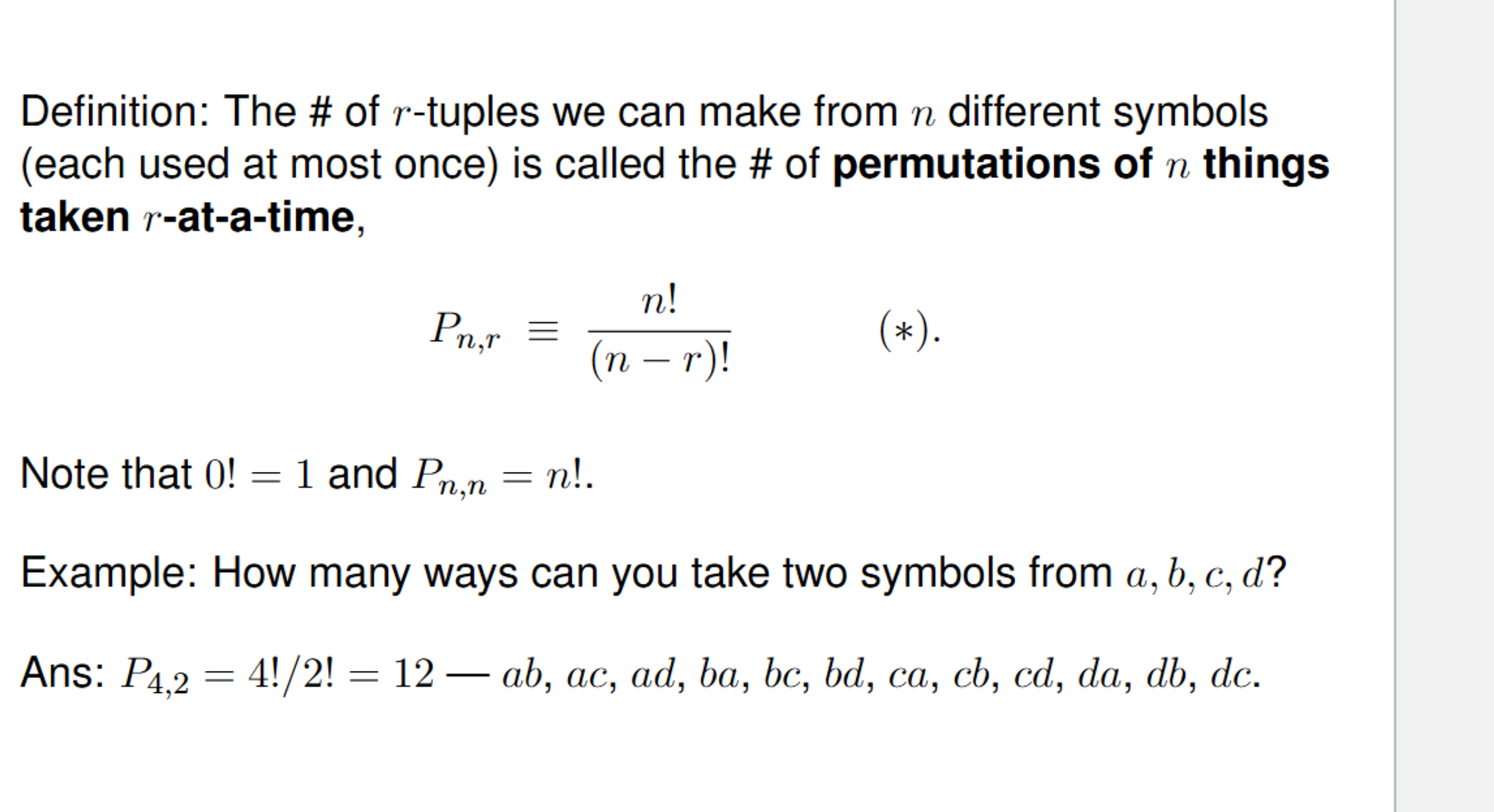
Permutations
A permutation is the arrangement of items in a specific order. (order matters)
choose .
Combinations
Order does not matter; therefore, the # number is smaller.
Add r! to denominator
if
Theorems
Sampling
Without replacement
objects of type A and objects of type B
Given types A and B and that choose K of type A, choose N total
A choose K times B choose n-k
divided by
# of ways to choose n out of a + b
Independence vs Disjoint
Independence = one event does not affect the chances of the other happening Disjoint = Both events cannot share an outcome
Series
Geometric =